

MP E&C C5621 Zero liquid discharge (ZLD) for molybdenum effluent
Two liquid effluent streams were generated by transforming concentrates into molybdenum and rhenium products. However, strict environmental regulations imposed upon Chilean copper giant Codelco prohibited liquid effluent discharge of any nature.
The effluent treatment plant JordProxa designed and constructed to treat this effluent, recovers clean water from this combined effluent stream for recycle to process, whilst converting the ferrous compounds into a stable, solid residue that is used to de-ice roads in the nearby high Andes mountains. Arsenic is also removed, in a stable form within the residue rather than accumulating within the recycled water.
A two-stage process was used to achieve this; chemical pre-treatment followed by evaporation and crystallisation. The result was a significantly more compact and cost effective plant, compared to a conventional effluent treatment plant.
The pre-treatment stage was accomplished in four steps: oxidation, lime precipitation, softening and neutralisation. After these steps the effluent was a relatively pure mixture of sodium sulfate and sodium chloride. The second stage evaporation system operated as a Zero Liquor Discharge (ZLD) crystalliser, with no purge of concentrated brine and with the mixed sodium chloride and sodium sulfate salt discharged in solid form.

Interested in evaporating and crystallising systems?



NEW ENERGY E&C JPA1001 Arctic climate for next battery chemicals plant
JordProxa has designed and is currently constructing three crystallisation plants for this site; for nickel sulphate, ammonia sulphate and cobalt sulphate. The production capacity of the battery chemicals plant will be 170,000 tpa of nickel sulphate and 7,400 tpa of cobalt sulphate. This amount of nickel sulphate should prove to be enough to produce around 1 million electric vehicle batteries per year. The cobalt sulphate capacity covers around 300,000 per year.
Perhaps the most important challenge faced was the logistics of coordinating delivery of large components to site and optimising installation in the limited operating window of the short summer season. JordProxa adopted a two-pronged strategy to achieve this. With diameters approaching 10 metres in diameter, the draft tube baffle crystalliser vessels were too large to ship to site in one piece. These were instead transported to the remote site in segments, late in the Finnish winter. This allowed final welding to be carried out in the warmer summer months, inside the plant building that our client had erected the previous summer.
The second prong of the strategy was to deliver the balance of plant in modular form, with the advantage of again allowing quick installation and hook up on site. These modules were designed to be as large as practical, taking into account transportation constraints and materials handling capacity on site. Several were over 20 metres long. Cross section spans were approx 6 metres by 6 metres.


Interested in evaporating and crystallising systems?

NEW ENERGY E&C C7061 Battery grade nickel sulphate plant
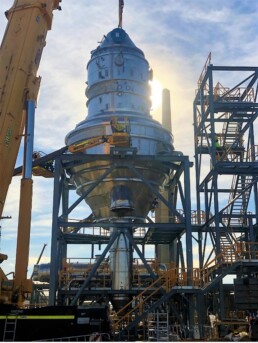
Due to the increase in the demand for nickel driven by the boom in the electric vehicles market, BHP decided to build a plant to convert its nickel product to extremely pure (battery grade) nickel sulphate hexahydrate. The last step of that process was the crystallisation plant.
The crystalliser plant is designed to produce 100,000 tonnes per year of pure nickel sulphate hexahydrate at a purity of 99.95%. JordProxa’s crystalliser design will ensure optimum crystal size and size distribution, to ensure trouble free centrifuge operation, with minimum impurities. The heart of the plant is a Draft Tube Baffle (DTB) crystallizer which produces large crystals with an average diameter of 1 mm or more. Careful considerations were given to the design to make sure the product met high purity battery grade specifications.
Although product purity Is necessarily paramount to sell into the battery chemical market, it is nevertheless important that the suppliers plant operate at high efficiency and low energy usage in order to achieve low operating costs. JordProxa’s design pioneers the use of Mechanical Vapour Recompression (MVR), which costs less to run than steam driven crystallisers where steam is not a by-product available at negligible or no cost. It also requires very little water to condense the evaporated vapours, unlike steam driven systems.
JordProxa worked closely with BHP’s project team to develop a solution which not only met their process objectives, but which was easy to install. To minimize the site installation work, which was a key objective, we provided a modular plant complete with piping, instrumentation and control wiring.
Interested in evaporating and crystallising systems?

NEW ENERGY E&C JPA1000 Modular delivery for new lithium plant
Albemarle is a leading USA specialty chemicals company. Its lithium mine at Greenbush W.A. supplies 30% of the world’s lithium production in 2016, in the form of high quality spodumene. Albemarle is developing a plant in nearby Kemerton, to convert the spodumene into lithium hydroxide monohydrate.
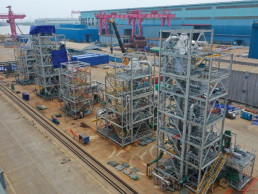
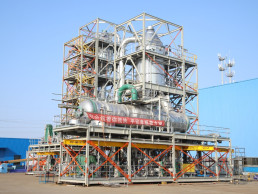
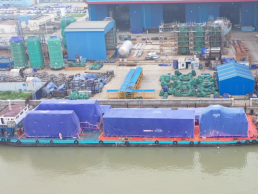
Albemarle’s Kemerton plant will initially comprise two trains, each producing 20,000 tpa LiOH.H₂O. Each train requires several crystalliser units that remove impurities from the lithium product. JordProxa will supply various crystallizer modules. Services include Caustisation evaporation, Anhydrous Sodium Sulphate crystallisation and Sulphate of Potash crystallization. The purpose is to separate sodium from lithium, with minimal lithium loss and the least retention of sodium in the product stream. A further objective is to handle the lithium plant waste streams in an environmentally sensitive manner that enables Zero Liquid Discharge (ZLD).
The forced circulation crystallisers will operate continuously for long run lengths, providing safe and efficient plant operation with minimal operator intervention. Tailored design features ensure low energy usage and minimum operating costs are achieved without compromise to product purity or recovery.
Residence times and slurry densities in the crystallizers are carefully controlled to produce well-sized crystals which can be separated with low residual contents of entrained liquor. Continuous, high efficiency cake washing is employed on the pusher centrifuges to greatly reduce the concentration of any impurities in the entrained liquor. The overall energy input to the plant, both as steam and electrical power, has been minimised by using mechanical vapour recompression at high compression ratios for all evaporative vessels.
Interested in evaporating and crystallising systems?