

NEW ENERGY DC C6284 & C6257 The David and Goliath of waste to energy ACCs
The first ACC was big, condensing 460 tons per hour of steam for a 120 MW power plant that converts municipal waste into electricity for the city grid. Two dozen fans, each 32ft in diameter, use clean air as the medium to condense this steam. Despite being located near the ocean, air rather than water was selected as the condensing medium, for its considerable environmental benefits. Close attention was paid to safe erection of the ACC, given the elevation of the fan drive decks, some 20m off the suspended floor below them.
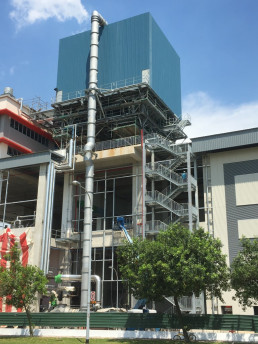
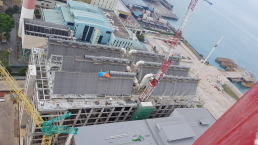
The second ACC – the David of the two – is an order of magnitude smaller, producing just 2.8 MW of power. But its purpose is noble, using as its fuel source the not inconsiderable tree clippings harvested from the roadsides of this tropical island. Space constraint was an issue on this project, as the accompanying image attests. Designing the structure to accommodate this elevated ACC proved a considerable challenge.



O&G DC C6177 & C6169 Modular dry cooling systems for Trinidad fertilizer plant
Ocean shipments involving modules of this size require extra care in finalising design calculations, given the pitch, roll and yawl forces that a journey of this nature has to endure.


Interested in power generation?

O&G DC FT&C C4094 and C7323 5,000km up the Amazon River
With the mighty Andes mountain range prohibiting access by road from Lima to site, transporting the equipment safely to site caused heads to scratch.
The optimal route of transporting the 18 air coolers and 9 scrubber vessels was a 5,000 km barge journey to the upper reaches of the Amazon river. Meeting the project schedule was critical, as the river is only navigable for a short duration after the wet season. Any delay would push the plant start up back 12 months.
The air coolers were delivered in modular form, to provide better protection during the long voyage from Jord’s Asian based fabrication centre. Close attention was paid to corrosion protection of the coolers and scrubbers, given the many months of ocean and river travel, between workshop and site.
The high pressure scrubbers vessels used a combination of internals; multi-cyclones for solids removal and vane packs for liquids. Maximum flexibility was incorporated into the designs, to handle 28 operating cases over four phases of the gas plants expected design life.


Interested in dry cooling systems?

O&G DC C3628 Viscous service air coolers for Saudi Arabia

The lube oil recirculation coolers for Saudi Aramco featured cover plate headers to allow easy internal access to service turbulator inserts, often used on viscous services to increase the tube side heat transfer coefficient.
Cover plate headers are also used for dirty services, such as refinery bitumen coolers, where internal tube access is required to clean the air coolers to get rid of internal fouling.

Interested in dry cooling systems?

O&G DC A377 Air cooler train for Karratha LNG
Jord’s scope for this project comprised process and mechanical design, including comprehensive finite element, structural, vibrational and noise analysis. Procurement, manufacture, performance testing and delivery to site.
Jord delivered 71 air cooler bays, measuring 16m (L) x 6m (W), and weighing up to 70 tons, in a fully assembled condition to Woodside’s LNG Train IV plant. The units featured a custom designed, high performance, robust fan drive bearing system to withstand the rigorous demands of this service. Three ships were charted to transport the units direct from Korea to site.


Interested in dry cooling systems?

O&G DC C5479 Air coolers for petrochemical service
The order for this project was received from our Canada based customer by our Australian office. Utilising our Korean alliance partner’s workshop Jord was able to deliver the units to our customer’s sulfuric acid plant in Saudi Arabia on time and on budget.
The oversize units measured 5.5m wide by 18.9m long per bay. There were 17 bays per plant and 3 plants in the project.


Interested in dry cooling systems?

O&G DC C7046 ACC modules for LNG expansion project

The remote location of this LNG plant demanded close attention be paid to delivery logistics. The customer was also particularly concerned that everything would fit together on arrival in Irian Jaya.
For the air-cooled condenser (“ACC”) supplied by Jord, the optimal mode of delivery was to barge the 2,500 tons of individual components to a yard located near to the site, assemble the ACC bundles and fan drive deck into modular sections and then shift these sections – 6 in total – the final few kilometres, for site erection onto Jord’s prior-delivered and assembled steel structure.
Site conditions allowed for a single hook lift only for the six main modules – each of them of 24 tubes, measuring 30m by 10m and 16m high, and weighing 300 tons – to be lifted 20m up onto the super structure.
The primary concern was to avoid deflection of the modules as they were being lifted. To meet this concern, Jord designed a cascading lift arrangement with a carefully calculated centre of gravity. The main beam of this “Modulift” spreader system spanned 20m, and added another 25 tons to the load on the crane and hook.
To ensure that everything would fit together, a Factory Acceptance Test of one complete fan module took place prior to barging the components to the assembly yard.
Interested in dry cooling systems?

POWER DC C1300 & C5417 Whatever the weather
The top photo shows Jord ACCs in Saudi Arabia. They were specifically designed to cope with harsh desert conditions, where sand storms are not uncommon and summer temperatures can reach 50 deg C.
At the opposite end of the temperature spectrum, the ACC in the bottom photo has been designed to operate at ambient temperatures as low as – 45 deg C. The unit is located at an ammonia plant some 400 km north of Moscow.

Interested in dry cooling systems?

POWER DC F1058 Vacuum Steam Condenser, China
This ACC unit is a multi-row design and was supplied for a Hydrogen Compressor service in the north west of China.
The unit was unusual in that it was built in accordance to API 661 specification (an air cooled heat exchanger specification developed for the petroleum industry).
Interested in dry cooling systems?

POWER DC K218 Vacuum Steam Condenser, Korea
Jord designed, manufactured and commissioned the single row vacuum steam condenser for a 130MW combined cycle power plant. The advantage of a single row design is that freezing conditions are more easily overcome.
Interested in dry cooling systems?